salmon run trip, 15 October 2005
Oct. 18th, 2005 11:50 pm![[personal profile]](https://www.dreamwidth.org/img/silk/identity/user.png) jinian
jinianWent with the bio club and honor society last Saturday to the Cedar River in Renton (southeast of Seattle) to see the salmon run. It turns out to be a crummy year for salmon on the Cedar River, actually; about 300,000 were expected, but the fish folks have only seen 80,000. Some of them refused to commit to a guess about the reason, but everyone mentioned global warming. Lake Washington is one degree F warmer this year, which is significant if you're a cold-water fish species.
We stood around campus for about an extra half-hour (I was 20 minutes early to start with) waiting for rented vehicles, but eventually we got on the road -- and promptly had to stop for gas.
![[Beaver pond off the Cedar River]](https://p2.dreamwidth.org/2a64ef68422e/678086-275251/underhill.hhhh.org/~igg/salmon15oct05/01-cedar-river.jpg)
There's an information stand at the entrance to the Cavanaugh Pond area of the Cedar River watershed, which is staffed with volunteers giving tours at various times during the next few weekends. One of the volunteers who also happened to be a UW bio department counselor acted as our tour guide on Saturday. The riverbanks are somewhat developed, so what we walked on during the tour was a gravel fill put in place to stabilize the river's course. Water can get through it, so this low place had become a pond instead of an option for oxbows. Beavers (or similar?) apparently live in it, though we couldn't see their lodge, which they move yearly.
![[Sockeye salmon in the river]](https://p2.dreamwidth.org/de4a4a8b693d/678086-275251/underhill.hhhh.org/~igg/salmon15oct05/02-sockeyes.jpg)
We could maaaybe see some salmon as we walked along the weed-infested trail (Himalayan blackberries, of course; buddleia, knotweed, phlox!, stinky-Bob), but we didn't get a clear view until we reached the bank above the fish weir. There were cheap paper-framed polarized glasses, which did cut the glare off the water somewhat, helping us see the fish, and they seemed also to help those with more sophisticated cameras take good photos of the fish.
Breeding-ready sockeye salmon really are bright red and olive green! I knew, but it was still neat to see.
![[Fish weir blocking the river]](https://p2.dreamwidth.org/6e7e45beb2bc/678086-275251/underhill.hhhh.org/~igg/salmon15oct05/03-weir.jpg)
![[Fish are funneled into cages for sorting]](https://p2.dreamwidth.org/ca76b48171ff/678086-275251/underhill.hhhh.org/~igg/salmon15oct05/05-weir-cages.jpg)
![[Sophisticated fish transport system: zip-ties and inner tubes]](https://p2.dreamwidth.org/8490e07c0679/678086-275251/underhill.hhhh.org/~igg/salmon15oct05/04-inner-tube.jpg)
The entire river is blocked by the weir, which staff can walk across on to retrieve fish from the cages they're forced to swim into. Mostly they catch sockeyes, which are actually an introduced species for recreational fishing on Lake Washington -- they stay in fresh water for a year or two after hatching, which the native Cedar-River salmon don't. If a chinook or coho (both endangered species) gets into the cages, the observers release them upstream right away so they can get spawning. Sockeyes are removed from the cages, put into an inner tube, and taken away to the hatchery.
The Cedar River hatchery improves the spawn's survival odds by protecting the eggs until they hatch, but fry are immediately set free. Older hatcheries often fed the fry by broadcasting pellets on the water surface, but that caused problems because salmon don't naturally feed like that. The smolts released after learning to eat that way were less able to find food, which is mostly on the bottom of the river in the wild, and actually interfered with the life cycle of the freshwater mussel by not feeding there! The mussels don't broadcast their eggs unless they're stimulated by a fish brushing against them, because the larvae have to live (harmlessly) in a fish's gills for a while. Young salmon failing to brush against mussels for many years meant few mussels made it to adulthood, and mussels are pretty integral to the health and cleanliness of lakes.
![[A view downstream]](https://p2.dreamwidth.org/2a9109b83f41/678086-275251/underhill.hhhh.org/~igg/salmon15oct05/06-downstream.jpg)
We followed a trail to a downstream view of the river, but didn't see many salmon there either. One later run of salmon comes into the beaver pond to spawn, along a channel to the left of this photo.
On the way back along the trail I pointed out a bunch of plants to a new acquaintance, including a baldhip rose (Rosa gymnocarpa). Never having tried its hips, I nibbled one and found it excellent for a rosehip -- vitamin C was the main flavor, but I'd gotten a nice deep red one and there was plenty of sugar as well, plus a slight scent of rose-floral. Must plant one of those.
Optional slightly disturbing photo: This deceased chinook salmon shows several of the effects of a breed-and-die agenda: The mouth is locked open (and some flesh has worn off the lower jaw from hitting rocks in the river), and the jaws have grown more hooked, because males fight to fertilize and protect eggs; and there are a large number of fungal or bacterial colonies on the body, because the immune system just isn't a priority after salmon return to fresh water. It's a crummy photo, but check out the teeth.
![[Big nasty pointed]](https://p2.dreamwidth.org/bf9c949df12c/678086-275251/underhill.hhhh.org/~igg/salmon15oct05/08-teeth.jpg)
![[Tanker truck labeled 'FISH']](https://p2.dreamwidth.org/51fe722064fe/678086-275251/underhill.hhhh.org/~igg/salmon15oct05/09-truck.jpg)
Here's where the sockeyes get their lift to the hatchery, where they will be conked on the head and milked of their gametes. After seeing Mr. Dead Chinook, it doesn't sound quite as bad to me.
We were off to Landsburg Park, too, for the next stage of our education.
![[River with rapids and flood markers]](https://p2.dreamwidth.org/7467df60ea86/678086-275251/underhill.hhhh.org/~igg/salmon15oct05/10-kayak-run.jpg)
This beautiful part of the river is all human-sculpted. Years ago, there was a pipe running across the river, which water could go over but which kept salmon out. Seattle's drinking water all comes from the upstream portion of this river, and nobody wanted all those rotting fish in it. Ecologically, of course, it turned out to be bad for the salmon to keep them out of miles of habitat and bad for the local animals and plants to deny them their fish snackies. (Hatchery fish used to be thrown in the landfill rather than the forest, sheesh.) Among other benefits, salmon runs bring halides farther up into the mountains than they would generally come, so we don't get cougars with goiters or anything.
When the county decided to revamp the pipe crossing so salmon could come up the river, they worked with a kayaking organization, so the above view is (1) pretty, (2) salmon-accessible, and (3) part of a rated kayaking course. I didn't get any pictures showing the pipe, but it's still in the riverbed, in that last bit of smooth water before the rocks start, bringing water to the city.
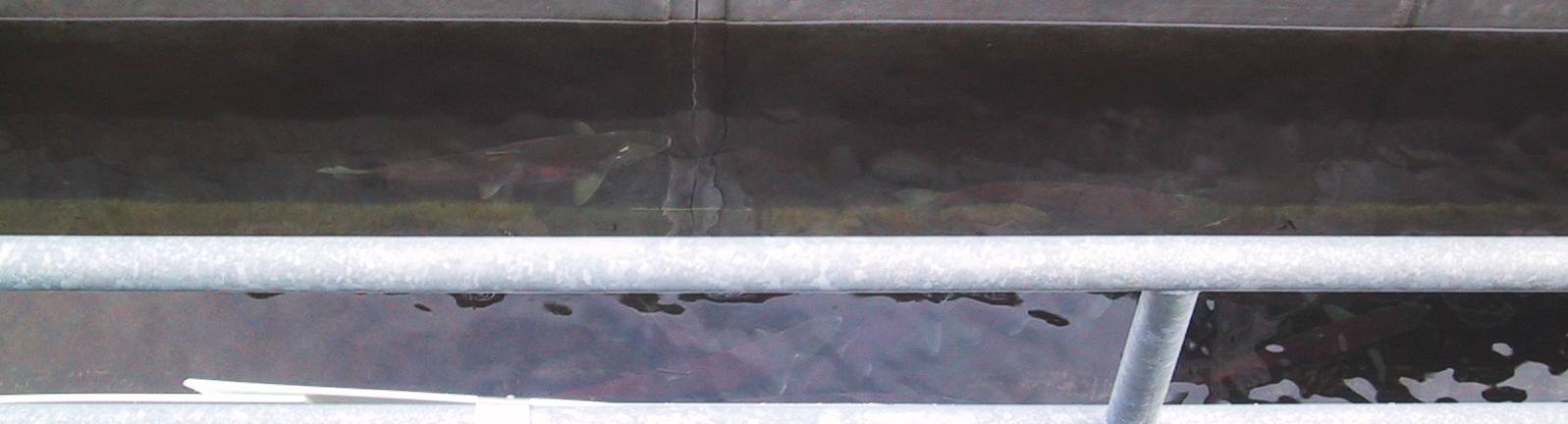
![[Sockeyes in calm water]](https://p2.dreamwidth.org/be964ddff230/678086-275251/underhill.hhhh.org/~igg/salmon15oct05/11-sockeyes.jpg)
![[Marshaling their strength to move upstream]](https://p2.dreamwidth.org/dc41d7c27328/678086-275251/underhill.hhhh.org/~igg/salmon15oct05/12-sockeyes.jpg)
There were more sockeyes in the river here, and more dead salmon out on the lawn in the park. No one was sure how those had gotten there. None of the pictures I got adequately shows the redds in the gravel (salmon nests, the gravel cleaned by sweeps of the female's tail), but there were some here. These sockeye must have slipped through when other salmon were released from the weir, because they certainly weren't supposed to be at this point in the river:
![[No spawn for you!]](https://p2.dreamwidth.org/15e261fdc0f3/678086-275251/underhill.hhhh.org/~igg/salmon15oct05/13-no-sockeye.jpg)
We had to have a tour guide for the next part; it had just been courtesy before, but no one is allowed into the water-processing area without an approved escort.
![[Log boom across a still pond]](https://p2.dreamwidth.org/b874b74b4e98/678086-275251/underhill.hhhh.org/~igg/salmon15oct05/14-log-boom.jpg)
This log boom is the first line of defense against "chewable chunks" in Seattle's drinking water. It rakes out logs and branches so the equipment isn't damaged. Though loud in parts, the water-treatment area was very serene too. I wonder if it's busy on weekdays.
![[Dam it! (oh, come on, I had to.)]](https://p2.dreamwidth.org/1dbe9b2aae45/678086-275251/underhill.hhhh.org/~igg/salmon15oct05/15-dam.jpg)
The river is dammed and the water forced to fall from a height so that salmon don't go this way. They want them to take the fish ladder, shown later. (I may be a little confused about this part.)
![[19- Seattle Water Works -30]](https://p2.dreamwidth.org/db6ed06e70fc/678086-275251/underhill.hhhh.org/~igg/salmon15oct05/16-water-works.jpg)
Many of the original buildings were still around, including river-rock outhouses that none of us chose to try out.
Our guide mentioned that shortly before the September 11 terrorist attacks she'd gotten someone on a tour who was very interested in what would happen if someone sabotaged the water works (not much, we have a two-week reserve supply stored nearer town) or crashed a toxin-laden 747 into the river (it would wind up pretty dilute and they'd notice anyway).
![[Grated and fenced, directing water below]](https://p2.dreamwidth.org/ac0a9e3ecde5/678086-275251/underhill.hhhh.org/~igg/salmon15oct05/17-routing.jpg)
Under this platform is a fish ladder. I stuck the camera lens between the grating bars for a shot of it:
![[Fast, dangerous-looking water]](https://p2.dreamwidth.org/47b215ff889d/678086-275251/underhill.hhhh.org/~igg/salmon15oct05/18-ladder.jpg)
Salmon have a tropism for the fastest-rushing water around them, even when they're descending the river. They just have to put their faces into the current, so a lot of smolts reach the ocean tail-first.
![[Schematic of ladder and sorting area]](https://p2.dreamwidth.org/b95cf3f2d67f/678086-275251/underhill.hhhh.org/~igg/salmon15oct05/19-schematic.jpg)
I had to squeeze in for this shot of the schematic for this part of the waterworks, which meant I cut off half of "Pescalator" on the right. Furthermore, the best part of the schematic is too small to read. But I can fix that:
![[FREEDOM TUBE!]](https://p2.dreamwidth.org/58a63027de78/678086-275251/underhill.hhhh.org/~igg/salmon15oct05/20-best-part.jpg)
![[Archimedes fish-screw]](https://p2.dreamwidth.org/5f3ac8c5e6c9/678086-275251/underhill.hhhh.org/~igg/salmon15oct05/21-screw-tube.jpg)
Plus, I have this photo of the actual Pescalator and Freedom Tube. Sadly, the Pescalator wasn't running because they didn't have many fish coming in at the time. I really wanted to see it.
Separate but equal sockeyes [pic not scary, just big]
The male and female sockeyes are kept separate in the holding pens so they don't do any illicit spawning.
![[Just needs a few more chemicals to be drunk]](https://p2.dreamwidth.org/807dcdd8273a/678086-275251/underhill.hhhh.org/~igg/salmon15oct05/23-drinking-water.jpg)
Under the platform there's a fenced-in V-shape so that the fish coming into the enclosure stay in the V and out of the filtered side areas. The water from the sides is taken off in a pipe to be chlorinated and fluoridated (we were briefed on the exit routes uphill if the chlorine gas were to leak), then it goes through the pipe under the kayak course and winds up in my tap.
I was hoping for the RIVER OF SALMON you see in the nature shows, really, and I didn't get anything like that. Still, pretty nifty stuff, and it was fun to hang out with other bio geeks.
We stood around campus for about an extra half-hour (I was 20 minutes early to start with) waiting for rented vehicles, but eventually we got on the road -- and promptly had to stop for gas.
There's an information stand at the entrance to the Cavanaugh Pond area of the Cedar River watershed, which is staffed with volunteers giving tours at various times during the next few weekends. One of the volunteers who also happened to be a UW bio department counselor acted as our tour guide on Saturday. The riverbanks are somewhat developed, so what we walked on during the tour was a gravel fill put in place to stabilize the river's course. Water can get through it, so this low place had become a pond instead of an option for oxbows. Beavers (or similar?) apparently live in it, though we couldn't see their lodge, which they move yearly.
We could maaaybe see some salmon as we walked along the weed-infested trail (Himalayan blackberries, of course; buddleia, knotweed, phlox!, stinky-Bob), but we didn't get a clear view until we reached the bank above the fish weir. There were cheap paper-framed polarized glasses, which did cut the glare off the water somewhat, helping us see the fish, and they seemed also to help those with more sophisticated cameras take good photos of the fish.
Breeding-ready sockeye salmon really are bright red and olive green! I knew, but it was still neat to see.
The entire river is blocked by the weir, which staff can walk across on to retrieve fish from the cages they're forced to swim into. Mostly they catch sockeyes, which are actually an introduced species for recreational fishing on Lake Washington -- they stay in fresh water for a year or two after hatching, which the native Cedar-River salmon don't. If a chinook or coho (both endangered species) gets into the cages, the observers release them upstream right away so they can get spawning. Sockeyes are removed from the cages, put into an inner tube, and taken away to the hatchery.
The Cedar River hatchery improves the spawn's survival odds by protecting the eggs until they hatch, but fry are immediately set free. Older hatcheries often fed the fry by broadcasting pellets on the water surface, but that caused problems because salmon don't naturally feed like that. The smolts released after learning to eat that way were less able to find food, which is mostly on the bottom of the river in the wild, and actually interfered with the life cycle of the freshwater mussel by not feeding there! The mussels don't broadcast their eggs unless they're stimulated by a fish brushing against them, because the larvae have to live (harmlessly) in a fish's gills for a while. Young salmon failing to brush against mussels for many years meant few mussels made it to adulthood, and mussels are pretty integral to the health and cleanliness of lakes.
We followed a trail to a downstream view of the river, but didn't see many salmon there either. One later run of salmon comes into the beaver pond to spawn, along a channel to the left of this photo.
On the way back along the trail I pointed out a bunch of plants to a new acquaintance, including a baldhip rose (Rosa gymnocarpa). Never having tried its hips, I nibbled one and found it excellent for a rosehip -- vitamin C was the main flavor, but I'd gotten a nice deep red one and there was plenty of sugar as well, plus a slight scent of rose-floral. Must plant one of those.
Optional slightly disturbing photo: This deceased chinook salmon shows several of the effects of a breed-and-die agenda: The mouth is locked open (and some flesh has worn off the lower jaw from hitting rocks in the river), and the jaws have grown more hooked, because males fight to fertilize and protect eggs; and there are a large number of fungal or bacterial colonies on the body, because the immune system just isn't a priority after salmon return to fresh water. It's a crummy photo, but check out the teeth.
Here's where the sockeyes get their lift to the hatchery, where they will be conked on the head and milked of their gametes. After seeing Mr. Dead Chinook, it doesn't sound quite as bad to me.
We were off to Landsburg Park, too, for the next stage of our education.
This beautiful part of the river is all human-sculpted. Years ago, there was a pipe running across the river, which water could go over but which kept salmon out. Seattle's drinking water all comes from the upstream portion of this river, and nobody wanted all those rotting fish in it. Ecologically, of course, it turned out to be bad for the salmon to keep them out of miles of habitat and bad for the local animals and plants to deny them their fish snackies. (Hatchery fish used to be thrown in the landfill rather than the forest, sheesh.) Among other benefits, salmon runs bring halides farther up into the mountains than they would generally come, so we don't get cougars with goiters or anything.
When the county decided to revamp the pipe crossing so salmon could come up the river, they worked with a kayaking organization, so the above view is (1) pretty, (2) salmon-accessible, and (3) part of a rated kayaking course. I didn't get any pictures showing the pipe, but it's still in the riverbed, in that last bit of smooth water before the rocks start, bringing water to the city.
There were more sockeyes in the river here, and more dead salmon out on the lawn in the park. No one was sure how those had gotten there. None of the pictures I got adequately shows the redds in the gravel (salmon nests, the gravel cleaned by sweeps of the female's tail), but there were some here. These sockeye must have slipped through when other salmon were released from the weir, because they certainly weren't supposed to be at this point in the river:
We had to have a tour guide for the next part; it had just been courtesy before, but no one is allowed into the water-processing area without an approved escort.
This log boom is the first line of defense against "chewable chunks" in Seattle's drinking water. It rakes out logs and branches so the equipment isn't damaged. Though loud in parts, the water-treatment area was very serene too. I wonder if it's busy on weekdays.
The river is dammed and the water forced to fall from a height so that salmon don't go this way. They want them to take the fish ladder, shown later. (I may be a little confused about this part.)
Many of the original buildings were still around, including river-rock outhouses that none of us chose to try out.
Our guide mentioned that shortly before the September 11 terrorist attacks she'd gotten someone on a tour who was very interested in what would happen if someone sabotaged the water works (not much, we have a two-week reserve supply stored nearer town) or crashed a toxin-laden 747 into the river (it would wind up pretty dilute and they'd notice anyway).
Under this platform is a fish ladder. I stuck the camera lens between the grating bars for a shot of it:
Salmon have a tropism for the fastest-rushing water around them, even when they're descending the river. They just have to put their faces into the current, so a lot of smolts reach the ocean tail-first.
I had to squeeze in for this shot of the schematic for this part of the waterworks, which meant I cut off half of "Pescalator" on the right. Furthermore, the best part of the schematic is too small to read. But I can fix that:
Plus, I have this photo of the actual Pescalator and Freedom Tube. Sadly, the Pescalator wasn't running because they didn't have many fish coming in at the time. I really wanted to see it.
Separate but equal sockeyes [pic not scary, just big]
The male and female sockeyes are kept separate in the holding pens so they don't do any illicit spawning.
Under the platform there's a fenced-in V-shape so that the fish coming into the enclosure stay in the V and out of the filtered side areas. The water from the sides is taken off in a pipe to be chlorinated and fluoridated (we were briefed on the exit routes uphill if the chlorine gas were to leak), then it goes through the pipe under the kayak course and winds up in my tap.
I was hoping for the RIVER OF SALMON you see in the nature shows, really, and I didn't get anything like that. Still, pretty nifty stuff, and it was fun to hang out with other bio geeks.


![[identity profile]](https://www.dreamwidth.org/img/silk/identity/openid.png)

no subject
Date: 2005-10-20 05:41 am (UTC)*happy bogglement*
Also the goitery cougars. Many fine bits. Thank you.